
traditional custom christmas lighting Built to Each Roofline
Christmas lighting in Kuna for two-storey homes, HOA entryways, and commercial properties with trees and signage
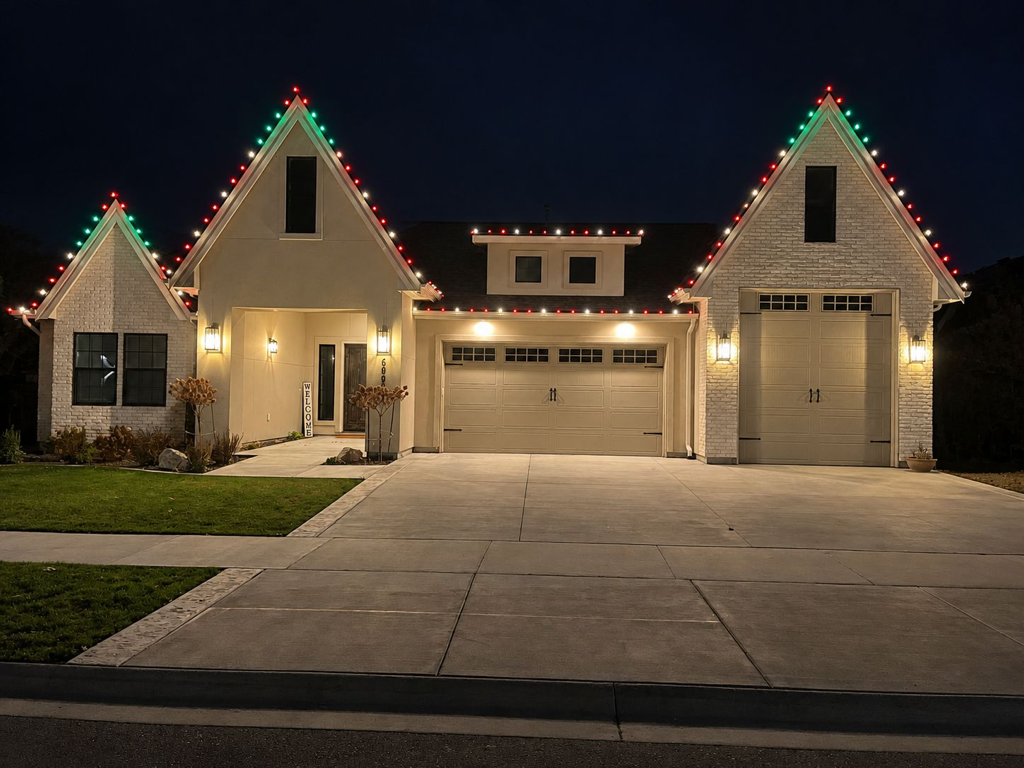
What separates a professional Christmas light installation from a DIY attempt is visible the moment the lights go on: no cords dropping down the siding to reach an outlet, no generic string pattern that ignores the actual shape of the roofline, and no sagging runs between anchor points. Strickly Lighting, a husband-and-wife team operating in Kuna and across the Treasure Valley, plans every installation to the specific structure—mapping cable routing before a single clip is placed so the finished result follows the roofline cleanly rather than approximating it. The owner has been hanging Christmas lights for 24 years, and that accumulated site-reading experience shows in how corners are turned, how trees are wrapped, and how HOA entryway signage is handled without visible power runs.
Two-storey homes with long front elevations and varied roofline heights are among the most common installation types in Kuna and Eagle, and they require planned cable routing from the outset—not extension cords run after the fact. The crew works through the layout for each property during the day, Monday through Friday and sometimes Saturday, so the installation is completed in a single focused visit. Commercial-grade lights are provided as part of the service and stay with you after the season; nothing is leased, and the lights can be stored at the property for reinstallation the following year.
Request a site visit to plan the layout for your home, HOA entryway, or commercial property before the installation season fills.
What the Installation and Removal Process Covers
Before installation begins, the crew plans the cable routing for the specific structure—identifying where power sources are located, how far each run needs to travel, and which anchor points will carry the line across the roofline without introducing visible sag. This planning step is what prevents the most common visual problems: cords hanging down the face of the building to reach an outlet, or gaps in coverage where a generic pattern did not account for a dormer, a side gable, or an entryway feature. On commercial properties and HOA entryways, trees and signs are mapped into the plan from the start rather than added as an afterthought.
Once installed, the lights follow the architectural lines of the property rather than running parallel to them from a distance. Roofline runs stay tight to the edge, tree wraps fill the canopy evenly, and sign lighting is routed so the cable path is not visible from the street. After the season, Strickly Lighting returns to take everything down, so the customer never needs to climb a ladder or manage the removal process independently. The commercial-grade lights remain the customer's property and can be stored on-site for the following year.
The service covers installation and seasonal removal for residential homes, commercial buildings, HOA common areas, trees, and signage. Custom layout planning is part of what the crew provides for each property, so the approach is specific to your structure rather than a standard package applied the same way regardless of the building.
Answers About How the Work Is Done
The questions below address how Christmas light installation is planned and executed for homes and commercial properties, including what the process involves for structures with longer rooflines and multi-feature layouts common in Kuna and Eagle.
How is the cable routing planned so cords do not hang down the side of the building to reach an outlet?
The crew maps the power source locations and the full cable path before installation begins, so runs are planned to travel along the roofline or hidden structural edges rather than dropping down the siding face.
What makes commercial-grade lights different from standard retail string lights in terms of how they hold up on a roofline installation?
Commercial-grade lights use heavier-gauge wiring, more durable socket housings, and bulb connections designed to stay secure through repeated handling, which matters for installations that are clipped to a roofline edge and removed at season's end.
How does the crew handle a two-storey home with multiple roofline levels, a dormer, and a covered entry?
Each section is planned individually—the main roofline run, the dormer edges, and the entry canopy—with the cable routing connecting them in sequence rather than treating the elevation as a single straight run.
What happens to the lights after the season ends?
Strickly Lighting returns after the season to take the lights down. The lights are yours to keep and can be stored at the property, so reinstallation the following year uses the same hardware without additional purchase.
How is an HOA entryway with both trees and signage planned differently than a standard residential roofline installation?
Trees and signs require separate routing plans because each feature has different anchor points and power requirements. The crew maps them as part of the overall entryway layout so the finished installation reads as a coordinated design rather than separate elements installed independently.
Strickly Lighting LLC also installs Christmas lighting in Meridian, Nampa, Boise, Caldwell, and Eagle. Call (208) 571-0027 to schedule a site visit and plan the layout for your property before the installation season books up.